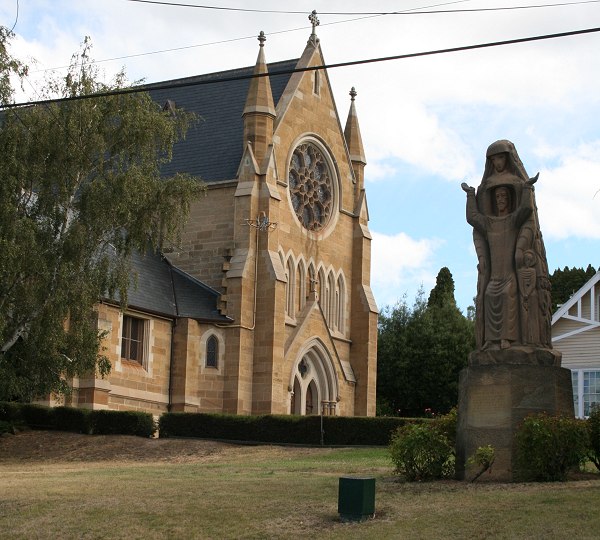
(Our Lady) Star of the Sea, Stanley (2)

Img_8405
Marshall St Stanley. Google Maps
Opened 1931, replacing an older building on the same site.

Img_8406

STANLEY.
Roman Catholic Church:
The work of demolishing the Church of Our Lady Star of the Sea was started on Monday, to make room for the proposed new church of the same name. Ono of the chief faults in the old church, which was built 32 years ago, is that the walls were solid, no cavity being left to prevent moisture coming through, and they there fore leak. The new building, of which Mr. H. S. East, of Launceston, is the architect, is to be Romanesque in design. The contractor is Mr. K. Howe, of Launceston. The building will be about 20 feet longer than the old one, the addition comprising the Sanctuary and Sacristies. The seating accommodation will also be slightly more than in the old building. It is expected that the new church will be finished before Christmas, and in the meantime divine service will be conducted in the large dining-room of the Presbytery, which has been set up as a chapel.
Advocate, 8 October 1930

Img_8408

“This stone was blessed and laid
By his Grace the Most Revd
Hayden Archbishop of Hobart
On Sunday November 9th 1930”

The New Church.
The foundation stone of the new church of Our Lady, Star of the Sea, was laid on Sunday morning after 11 o’clock mass by Archbishop Hayden. There was a large attendance. His Grace was welcomed to Stanley by the Rev. P. Adlum, B.A., the Warden (Cr. Dan Brown), Mr. Fergus Medwin, M.H.A., and Mr. W. McKenna of Irishtown. He congratulated the people on their pluck and their happy financial position, and hoped to be present at the opening of the church. Father Adlum reported that the cost would be £1883 4s, of which £1148 13s 1d was in hand, leaving a balance of £734 2s 11d, of which £146 18s 6d was donated after the ceremony. Mr. W. O’Neill returned thanks to the donors.

Circular Head Chronicle, 12 November 1930

Img_8407

New Roman Catholic Church:
The new Roman Catholic Church of Our Lady Star of the Sea at Stan ley is nearing completion, and it will be one of the best designed and appointed churches in the State. The architect is Mr. H. S. East, and the contractor Mr. K W. Howe, both of Launceston, and the contract price, exclusive of fittings, was £1780. To Messrs. W. Coogan and Co., Launceston, was entrusted the making of the high altar, the two side altars, linen press, vestments press, and altar rails, all of Tasmanian blackwood, the whole being designed by Mr. East. The high altar is at present on view in the show room of Messrs. Coogan in Brisbane street, and speaking of it at the weekend Mr. East said he was more than pleased with the workmanship which the firm had put into their contract. In his experience he had seldom seen bet ter work of the kind in any part of Europe, and it was a fine advertisement for Launceston that such high class workmanship could be executed there. The design of the altar is free Gothic, and it has a burnished gold dome over the tabernacle and two candelabra in a semi-circular arch framing the altar. These are reminiscent of the magnificent candelabra and the Capella Palatina at Palermo, Sicily. Splendidly grained blackwood has been used, and the effect is most beautiful, The church, which has been construct ed of brick, has seating accommodation for 125 persons, and it is stated that its furnishings will be the best of any Roman Catholic church in the country districts of the State.
Advocate, 22 December 1930

STANLEY.
Roman Catholic Church:
The work of rebuilding the Church of Our Lady Star of the Sea has been completed. It is now a very fine building, and an ornament to the town. The opening ceremony is to be at the eleven o’clock Mass on Sunday next, and in the absence of the Archbishop in Rome, will be carried out by Very Rev. Father Murphy, Vicar Capitular. The church has been remodelled in the Romanesque style, and sanctuary and sacristies added.
Advocate, 12 March 1931

Img_8410

A FINE BUILDING.
New R.C. Church at Stanley
CONSECRATION CEREMONY.
The Star of the Sea Church at Stanley, which during the past few months has been rebuilt, was opened on Sunday, when the seating accommodation was taxed to its utmost, the congregation including many adherents of other churches and visitors from Hobart, Launceston and practically all parts of the parish. The outward appearance of the building was highly commented upon, but the beauty of the interior eclipsed all expectations, and Father P. Adlum and his parishioners were congratulated on the results of their efforts.
[continued]
Advocate, 17 March 1931

Our Lady Star of the Sea Catholic Church, Stanley (1)

Opened 1897. Demolished 1930 and replaced by a newer building on the same site,

Photo

OPENING OF STANLEY CATHOLIC CHURCH
Sunday last was a red latter day for the Catholic portion of our little community , the new Catholic church being dedicated and blessed by the Very Rev. Dean Beechinor, of Launceston, ? The church was named the Star of the Sea. The Rev. Fathers Cunningham and Higgins (Burnie) assisted in the impressive ceremony. Dean Beechinor celebrated High Mass, Father Cunningham being deacon and Father Higgins sub deacon. The Dean delivered a simple but instructive sermon, and concluded his remarks by complimenting the Catholics of the district on the find building erected, also thanking members of other denominations for their kind and material assistant in the matter.
…
The new church is built of brick and is a substantial and handsome building. The nave is 40 feet long and 25 feet wide. The original plan shows the nave 50 feet with chancel and sacristy, which are to be constructed in the future, being deferred for the present owing to want of sufficient funds. The edifice as built is quite large enough for present requirements. Messrs Gunn, of Launceston were the builders and Mr Luttrel architect.

Wellington Times, 17 July 1897

Catholic Church to be Re-built
Owing to the leakage through the wall which were of solid brick, it has been deemed necessary to demolish the Church of Our Lady, Star of the Sea, which has stood in an unfinished state for more than thirty years. The work of dismantling has already commenced and it is intended, as soon as the site is cleared, to commence a new brick church, using the existing foundations, the new church will be modelled on the Romanesque style, the plans having been drawn by Mr H.S. East of Launceston. It is not intended to in crease the seating accommodation, but merely to add the sanctuary and sacristy which were not included in the old building. The reconstruction is in the hands of Mr. K. W. Howe of Launceston, and it is hoped that the building will be complete, and ready for use early in the New Year. The contract price for the building complete is £1985, including £30 for contingencies.

Circular Head Chronicle, 8 October 1930

STANLEY.
Roman Catholic Church:
The work of demolishing the Church of Our Lady Star of the Sea was started on Monday, to make room for the proposed new church of the same name. Ono of the chief faults in the old church, which was built 32 years ago, is that the walls were solid, no cavity being left to prevent moisture coming through, and they there fore leak. The new building, of which Mr. H. S. East, of Launceston, is the architect, is to be Romanesque in design. The contractor is Mr. K. Howe, of Launceston. The building will be about 20 feet longer than the old one, the addition comprising the Sanctuary and Sacristies. The seating accommodation will also be slightly more than in the old building. It is expected that the new church will be finished before Christmas, and in the meantime divine service will be conducted in the large dining-room of the Presbytery, which has been set up as a chapel.

Advocate, 8 October 1930

Catholic church, Westbury (1)

Built ? early 1850s?
Replaced 1874 with the opening of Holy Trinity Church

The progress of religion is not the less marked. There are now within the space of a few hundred yards at Westbury an Episcopalian, Wesleyan, and Roman Catholic church. The latter place of worship, capable of holding about two hundred persons, is regularly filled, but the services are at present only held on alternate Sundays, owing to the Rev. Mr. Hogan’s duties extending to Longford and Deloraine. A fine harmonium has recently been added to the church, and the singing is highly creditable.
Launceston Examiner, 11 December 1858

For some a years past it has been the earnest endeavor of the Rev. J. Hogan, the Catholic pastor of Westbury, and his congregation to secure a building for the worship of Almighty God commensurate with the growing necessities of the people, and the more modern ideas of church architecture. The old wooden church has outlived its purpose, and the procuring of a new building has been forced upon the members by irresistible circumstances.
Launceston Examiner, 21 May 1874

Catholic churches, Hobart

A TIMELINE

In 1822 a wooden chapel was constructed on the corner of Brisbane & Harrington St, near the present site of St Mary’s Cathedral.

As far back as 1817 Father Flynn called at the settlement, on his voyage from England to Sydney, and administered the sacrament, and four years later Father Connolly arrived and commenced his work. He celebrated mass at Mr. Curr’s store in Argyle-street, and there the congregation consisted of nine persons. Services were subsequently held in the old building in Elizabeth-street, known to us in later years as “Rats’ Castle.” Father Connolly having obtained a grant of 14 acres of land at the angle of Harrington and Brisbane streets, called it Mount Carmel, and in February, 1822, a small wooden church was commenced. It was finished in the following year, and dedicated to God, under the invocation of St. Virgilius.
The Mercury, 31 December 1904

Preceding this activity was the work of Father Connolly, accredited by the Colonial
Office in 1820 to Van Diemen’s Land, where the Inadequate weatherboard chapel of St.
Virgil which he was ‘ permitted to erect in 1822 functioned until 1836.

22 December 1941

About 1825 land was provided for the Catholic cemetery

It may not be generally known, that, adjoining the Roman Catholic Chapel in Hobart Town, a large site of ground has been given by Government as its burial-place.—Several persons have already been interred there; among whom was Private Thomson, of the 40th, who was followed to the grave on Saturday last by a detachment of that company.
Colonial Times, 19 August 1825
Continue reading →

St Mary’s Cathedral, Hobart

Img_9610

Originally opened in 1866, then rebuilt and reopened in 1881.
First part of this post deals with original building. Current building & photos are in second part of post.

Some background on the development of the Catholic church in Hobart.

Google Maps
History & features on Archdiocese website
Wikipedia page
Memorial Window
Organ

The erection of St. Mary’s Cathedral had engaged the attention of Bishop Willson throughout a great part of his episcopate. Mr. Roderic O’Connor had donated £10,000, £5,000 had been contributed from other sources, and on September 12, 1860, the foundation-stone was laid. Among those present upon that occasion were the Governor and Lady Fox Young, attended by Mr. N. Maule, A.D.C., and Major Douglas. The ceremony was an imposing one, and in the evening there was a Banquet at St. Peter’s-hall, in Collins-street, at which the Bishop presided, and among those present were Major Douglas, Mr. John Davies, M.H.A., Mr. Balfe, M.H.A., Mr. H. Hunter, and Mr. John O’Boyle. On the 4th July, 1866, Bishop Murphy having succeeded Bishop Willson, the dedication took place, the preacher being Dr. Shield the Bishop-elect of Adelaide.
Extract from “Hobart Churches”, The Mercury, 31 December 1904
Continue reading →

St Joseph’s Catholic Church, Launceston

Located in Margaret, near/adjoining/behind the site of the present day Church of the Apostles.
Foundation stone laid 1839.
Opened 1842.
Closed 1866, replaced by Church of the Apostles


Detail from a drawing by Magaret Black, 1852 (from the QVMAG QVM:1988:P:0041) showing St Joseph’s to the left of the city.

Details from a painting by Frederick Strange (QVMAG collection):


Roman Catholic Church, Margaret Church, c.1856

Prior to the opening of St Joseph’s, a temporary chapel was built in Cameron Street.

ROMAN CATHOLICS.
It will be seen by on advertisement in another part of our columns, that it is the intention or the Roman Catholics to establish a Chapel in this town, in order that they may ” worship God according to the manner of their fore-fathers.” The Catholics have hitherto had no fixed place of worship, and have been obliged to resort for an occasional performance of their duties, to any building which might offer for the purpose. The establishment of a Chapel must therefore be looked upon by every friend to Catholicity as a very desirable object, for, although we do not coincide with the doctrines which that religion ?aches to be necessary for salvation, yet, we ?e ever anxious to give equal support to every religious denomination.

[continued]
Cornwall Chronicle, 7 April 1838

Roman Catholics.— We are requested to state, that a temporary chapel has been erected in Cameron-street, for the accommodation of the Catholic portion of our community, at which place divine service is now regularly performed every Sunday morning, by the Rev. Mr. Cotham, according to the rites and ceremonies of that church.
Cornwall Chronicle, 25 August 1838
Continue reading →

Catholic Chapel, Hobart

As far back as 1817 Father Flynn called at the settlement, on his voyage from England to Sydney, and administered the sacrament, and four years later Father Connolly arrived and commenced his work. He celebrated mass at Mr. Curr’s store in Argyle-street, and there the congregation consisted of nine persons. Services were subsequently held in the old building in Elizabeth-street, known to us in later years as “Rats’ Castle.” Father Connolly having obtained a grant of 14 acres of land at the angle of Harrington and Brisbane streets, called it Mount Carmel, and in February, 1822, a small wooden church was commenced. It was finished in the following year, and dedicated to God, under the invocation of St. Virgilius.
The Mercury, 31 December 1904

ROMAN CATHOLIC CHAPEL
THE Resident Roman Catholic Clergyman in Van Diemen’s Land, in Furtherance of the Object with which he is intrusted, under the Authority of His Majesty’s Government, being desirous to put in Progress the Building of a suitable Place of Worship for the Roman Catholics, with the Sanction of His Honor the Lieutenant Governor, respectfully calls upon such of the Inhabitants as are disposed to give their Aid to this desirable Object, as connected with the good Order of a large Portion of the Persons already in Van Diemen’s Land, and of others probably yet to arrive ; and he respectfully requests to add, that a Subscription List is open at the under-mentioned Places :
At the Office of Edward Lord, Esq. ; of Messrs. Kemp and Co. ; of Edward Curr, Esq. ; at the House of P. A. Mulgrave, Esq. and at the Gazette Office, Hobart Town.
At the House of T. A, Lascelles, Esq. New Norfolk ; James Gordon, Esq. Pitt Water; and G. W. Gunning, Esq. Coal River.
At Port Dalrymple:-Thomas Archer, Esq. J. P.; Mr. Commissary Roberts ; T, C, Simpson, Esq. ; and James Cox, Esq. J. P.
Where the Contributions of all Persons will be thankfully received.
It is considered scarcely necessary to state, that the Catholic Community, for whose particular Accommodation and Good this Undertaking is about to be commenced, will be expected to give their Aid in every Shape in which it can be useful, and suitable to their Condition.

Hobart Town Gazette, 13 April 1822

I’m not sure on actual location on the chapel, but it appears to have been close to the corner of Harrington & Brisbane Sts. In 1831, an advertiser gives his location as “situated in Brisbane-street, at the corner of Harrington street, (opposite the Roman Chatholic Chapel). In 1833, a cottage is advertised for sale at the “premises in Brisbane street facing the Catholic Chapel”. In 1834, another advertiser gives his location as “opposite the Catholic Chapel, Harrington Street”.

St Michael’s Catholic Church, Campbell Town

Img_0701

Opened 29 September 1857. From panel on site:

Bishop Wilson was responsible for the construction of this bluestone church and his coat of arms and initials, WW, can be found on the south-eastern wall. Wilson has tried and failed to obtain land for the Church in the 1840s, but succeeded in 1857 and it was consecrated in September of that year.

Img_0703
Continue reading →