Cnr of Cameron and Tamar Street. Google Maps
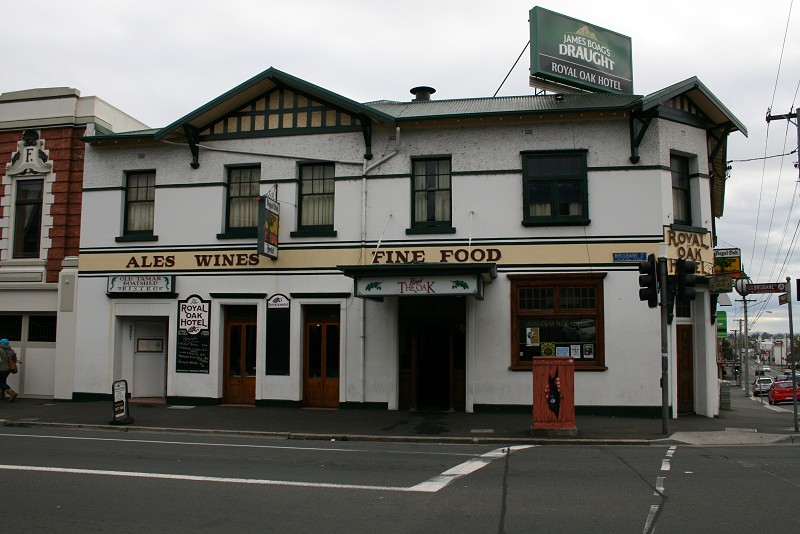
Cnr Brisbane & Tamar Streets. Google Maps
1834-43 Antonio Martini, Sawyer’s Arms, Tamar and Cameron-streets
1843-44 William Clarke, Sawyer’s Arms, Tamar and Cameron-streets
1844-46 William Clarke, Sawyers’ Arms, Brisbane and Tamar Streets (change of location)
1847 Benjamin Hyrons, Angel Inn, Brisbane and Tamar Streets
Unlicensed
1851-54 William Hedger, Royal Oak, Brisbane and Tamar Streets
1854-57 Mary Ann Hedger, Royal Oak, Brisbane and Tamar Streets
1857-63 William Job Harris, Royal Oak, Brisbane and Tamar Streets
1863-73 William Rankin, Royal Oak, Brisbane and Tamar Streets
1874-75 Elizabeth Fraser, Royal Oak, Brisbane and Tamar streets
1876-84 Joseph Bosswood, Royal Oak Inn, Brisbane and Tamar Streets
1884-92 John Thompson Royal Oak Hotel, Brisbane and Tamar Streets
1892-95 Mary Plaxton, Royal Oak, Brisbane and Tamar Streets
1895 Thomas Collins, Royal Oak, Brisbane and Tamar Streets
1895-98 Henry Charles Abbott, Royal Oak, Brisbane and Tamar Streets
1898-1900 Charles Fawkner, Royal Oak, Brisbane and Tamar Streets
1900 William Abbott, Royal Oak, Brisbane and Tamar Streets

View from Windmill Hill, 1860s, showing Tamar Street with Cameron Street on the left.
(cropped from photo in QVMAG Collection, QMV:1983:P:1196)

The two-story building opposite the Park gates, with a verandah top and bottom, was the Sawyers’ Arms, kept by Antoni Martini. In the year 1842 he let it to a man named Clark, who was a leading cricketer in those days; and he removed the license to the Royal Oak, corner of Brisbane and Tamar streets.
“Early Launceston,” 17 July 1897
[Antonio Martini] By 1823 he had received his ticket-of-leave and moved to Launceston. The same year he bought a town allotment in Tamar Street and three years later purchased adjoining land. In 1825 he received his certificate of freedom and built two dwellings on his land. One structure, a two-storey wooden building with verandah and balcony, was to become known as Martini’s Corner. About 1828 he rented this building to B Smythe, who conducted his Cornwall Collegiate Institution there until 1834, when Martini converted the building to a hotel, calling it the Sawyer’s Arms. He was the licensee until 1843.
About 1832 he started a timber business in partnership with William Burke: in 1833 Martini was listed as a sawyer in Launceston. In 1833 he married Mary O’Mara, who had arrived in Hobart on the Norval in 1830. They had a son, born in 1834, and a daughter, born in 1836. Mary died on 18 June 1836, soon after the birth of her daughter. In 1838 Martini constructed a wooden building in Cameron Street, next to his hotel on the corner of Tamar and Cameron streets, to serve as the first dedicated place of worship for the Catholics of Launceston. It was the Catholic Chapel from 1838 to 1842, when St Joseph’s was opened in Margaret Street. He built a brick hotel on the corner of Brisbane and Tamar streets in 1844. Later named the Royal Oak, it was leased by the Martini family to a succession of publicans until the 1950s when it passed out of the Martini family ownership. Antonio Martini died at his home in Tamar Street on 6 March 1867, aged eighty-seven years.
Launceston Historical Society Inc, Newsletter No 104, October 2007, p. 6 (pdf)
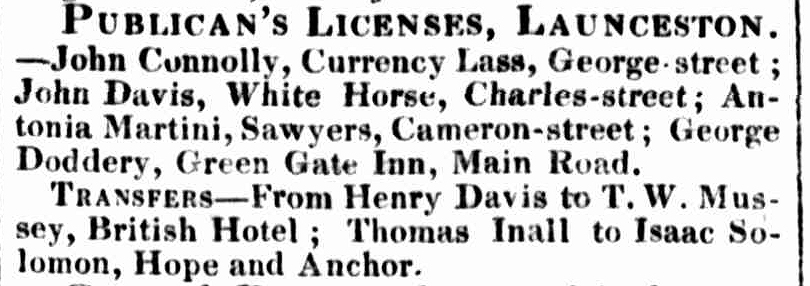
The Colonist, 20 May 1834
WILLIAM CLARKE, having succeeded Mr. Antonio Martini in that old established Inn known as the Sawyers’ Arms. Tamar-street, begs leave respectfully to solicit the support of his friends and the public in general.
WV. C. will prove lo those who may favour him with their support that his selection of Wines, Spirits, and Malt Liquors, are of the very best assortment — that his accommodation for travellers has been studied, to afford them every comfort ? — and that his Stables are attended to by an experienced Groom, and supplied with the best Provender. A single call will prove that W. C. is determined, by unremitting application to his business, to give satisfaction to those who may favour him with their support.
W. C. alto respectfully solicits a call from his friends 011 Monday, the 20th instant, as he intends to provide a Dinner for those who will favour him with their company (“Freeman’s Key.”)
* Dinner on the table at 1 o’clock.
The Cornwall Chronicle, 15 November 1843
From “Annual Licensing Meeting”
Transfers confirmed-J. Childs, Black Swan;
W. Clarke, Sawyers’ Arms;
. . .
In the application of William Clarke for the Sawyers’ Arms, Mr. Breton wished to take the sense of the meeting relative to the transfer of the license to the newly erected house at the corner of Brisbane and Tamar-streets. The application had been made in due course; but some of the neighbours having protested against it, Mr. Breton declined to act without the opinion of his brother magistrates. A discussion then ensued, some contending that the meeting had no juris diction, and others acknowledging Mr. Breton’s courtesy in submitting the subject for their consideration. It was asserted that the power of granting transfers was, by an error of law, accidentally vested in the police magistrate, but that a promise of amendment had been received from the colonial secretary. Mr. Atkinson thought the police magistrate had better take the sense of the neighbours. The question did not come to a division.
Launceston Examiner, 4 September 1844

On Wednesday morning considerable excitement was occasioned by a report that Mr. William Clarke, of the Sawyers’ Arms, had been dragged out of his house, and incarcerated in the watch-house, by Mr Midgeley, the Chief District Constable— the latter charging him in the first instance with “disturbing the public peace;” and in the second, with “resisting him in the execution of his duty.” Mr. Rocher attended on behalf of the accused. Mr. Midgeley stated, that about half-past seven o’clock the preceding evening, whilst sitting in his own house, his attention was attracted by hearing the screams of a female. On going to the door he saw defendant in the act of striking and kicking his wife, Mrs. E. Clarke. Witness immediately ran to her assistance, when defendant quitted his hold and seized witness by the collar. After a momentary struggle, defendant succeeded in dragging witness into the house, from which latter place he was again forced by witness, and ultimately, with the assistance of two other constables, was conveyed to the watch-house
[continued]
The Cornwall Chronicle, 24 January 1846
From “Annual Licensing”:
William Clarke, Sawyers’ Arms, Tamar and Brisbane-streets.
Mr. T. Bartley said that a proposition had been carried in 1842, when there were twenty-one magistrates present, that no person should receive a license who was living himself in an improper manner. That he was not a fit and proper person according to the Act, and therefore ineligible to keep a licensed house. Mr. Rocher, who appeared for applicant, here explained, in reference to an observation which had previously fallen from one of the magistrates — that counsel could not claim as a matter of right to address the bench — that he claimed to do so as a matter of right. If he was there on courtesy only, his observations would be shackled. Capt. Gardiner requested the proof of his right. Mr. Rocher said that it was the right of every British subject to appear by counsel where his liberty or his interest was likely to be involved, so long as he treated the tribunal before whom he pleaded with courtesy. Every man had a right to request a counsel to advocate his cause. The Police Magistrate said that Mr. Macdowell, who was well known in Hobart Town, only claimed to be heard on such occasions as a matter of courtesy, not as a right. Mr. Bartley said that no solicitor had a right to be heard ; and if he claimed this as a matter of right, the magistrates would not hear him. He would submit a motion, that a person could appear only as a matter of courtesy, not as a right. This motion would decide what they intended to do. Mr. Collett seconded it. The motion was put and carried, there being only one dissentient voice. Mr. Bartley said, that a person living in concubinage, as applicant was, could not be considered a man of good fame and reputation, as required by the Act, and that he should therefore vote against the renewal of the license. License refused.
Launceston Advertiser, 3 September 1846

From “Licensing Meeting”:
William Elliott, Black Horse, Brisbane street. Mr. Sams only voted in favour. Refused.
William Spearman, The Sawyers’ Arms, Brisbane and Tamar-streets. Mr. Sams for, the rest against.
John Waldron, for The Albion Hotel, York and George-streets Refused.
The three preceding licenses had been refused to former occupiers at the annual meeting.
Launceston Advertiser, 2 November 1846

Manning, James, corner of Brisbane and Tamar street; the highest recommendations, and supported by Mr. Walford, but refused as not being required.
Launceston Examiner, 2 September 1848
Applicants for Licenses, refused.
Bowater, John, Bricklayer’s Arms, Eardley street
Humphreys, Edward, Young Queen, George Town
Lette, Peter Lemond, Bush Inn, Patterson Plains
Madden, James, Mount Esk Inn, Brisbane & Tamar sts.
The Cornwall Chronicle, 2 September 1848
From “Licensing Meeting”:
Mr. James Johnstone formerly of the St. John’s Tavern, and now of Brisbane-street, applied for permission under the Act to remove his license to the house at the corner of Tamar and Brisbane streets formerly the Sawyer’s Arms, and then the Angel Inn but latterly unlicensed. The Police Magistrate had declined to use the discretionary powers vested in him, to permit the removal, on the ground, that a house there was not required, and the Justices now assembled being of a similar opinion, Mr. Johnstone was re- fused his application. We understand the Police Magistrate has also refused permission to transfer this license to the extensive premises of Mr. Gee, in Charles-street, being of opinion that there are sufficient licensed houses there already.
The Cornwall Chronicle, 10 February 1849

From “Quarterly Licensing Day”:
Mr. W. Hedger applied for permission to transfer his license [from the White Horse] to the premises at the corner of Brisbane and Tamar streets, and Mr. M. Monaghan to remove his to the house lately kept by Cook. In these two cases the power to grant or refuse was vested entirely in the police magistrate, but he wished to ascertain the sentiments of his brother justices for his guidance. With reference to Hedger’s application a favorable opinion was expressed, but the case of Monaghan was left exclusively to the decision of the police magistrate.
Launceston Examiner, 5 February 1851
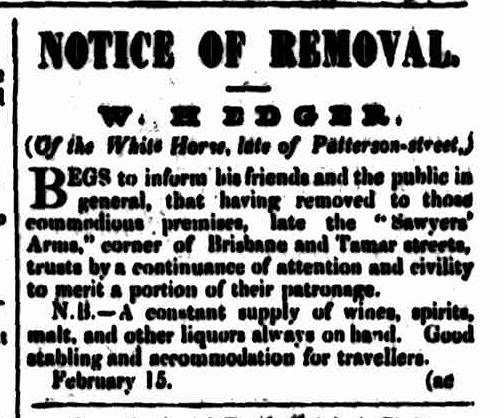
Cornwall Chronicle, 15 February 1851
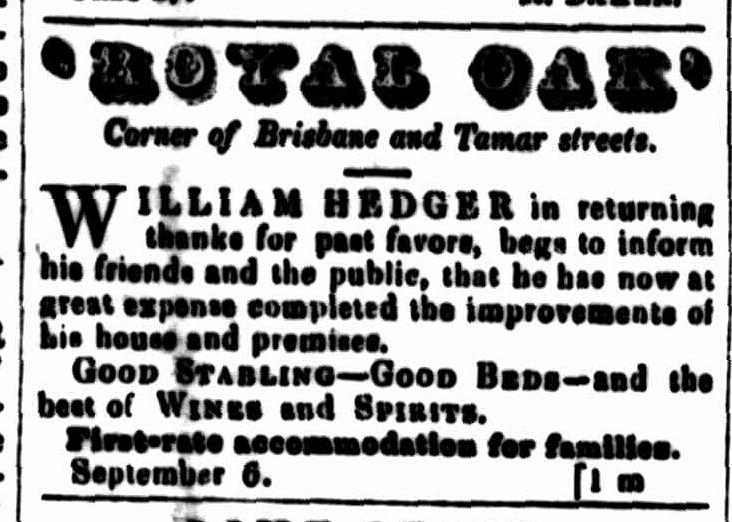
Cornwall Chronicle, 10 September 1851
W. Heilger, Royal Oak, corner of Tamar and Brisbane-streets ; granted. The police magistrate said there was one conviction ; Sunday trading had been carried on some time ago, but he believed nothing of the kind existed now ; the house was well conducted, cleanly and quiet.
Cornwall Chronicle, 4 September 1852
DIED.
On Sunday, 20th inst., at his residence, Brisbane-street, after a painful illness, Mr. William Walter Hedger, of the Royal Oak Inn, aged 36.
The funeral will take place on Wednesday at 3 o’clock, when friends are invited to attend.
The Cornwall Chronicle, 29 November 1854

PUBLIC-HOUSE FOR SALE
FOR SALE.—The lease and Goodwill, with Furniture, Stock, Fittings, &c., &c , of that old established house,
THE ROYAL OAK HOTEL,
Brisbane-street, corner of Tamar-street.
The house has always been doing a first-rate business, has lately been entirely repainted, papered and shingled. The furniture is nearly new, and very good, the accommodation excellent; has also a large room, hitherto used as a ball-room, but admirably adapted for a billiard-room, with suitable stabling, yard, &c.
The position of this Hotel is perhaps the best in town, as the new bridge at Patterson’s Plains will bring all the traffic from Evandale, White Hills, and Pattersons Plains, along the Elphin Road, past the doors, either going to town, or by Tamar-street to the Wharf and there is no licensed house on the road within 5 miles. The situation is healthy and beautiful, and equally convenient for town and country trade. To a respectable family this house would ensure a comfortable independence, perhaps a fortune, and is a desirable residence.
Terms will be moderate and easy, the present proprietor having to proceed to, Victoria.
Apply to MRS. M.A. HEDGER, Royal Oak Hotel. Brisbane street, Dec. 8
The People’s Advocate, 15 December 1856

Cornwall Chronicle, 5 August 1857
From “Quarterly Licensing Meeting”:
The next application was for a transfer of the license for the Clarendon Hotel, on the wharf, from Thomas Bruff to Mary Ann Hedger.
The Police Magistrate said he did not think Mrs. Hedger a proper person, being unmarred, to have charge of such a house, situated on the wharf, as the Clarendon Hotel was. He had observed that when Mrs. Hedger kept the Royal Oak, where some irregularities at night had occurred, another person appeared to conduct the business, and acted as master, and he thought such an arrangement was one which the magistrates ought not to sanction.
Mr. Sams said he had known Mrs. Hedger for 20 years, and she bore a good character, which was shown by the manner in which she had conducted the house she held last.
Mr. Miller said, as a resident near the Royal Oak, he had never observed the slightest impropriety.
Captain Reid bore similar testimony.
Commander Drew said the house was then conducted better than it was now.
Major Welman said in his perambulations he had seen nothing to complain of in the manner in which Mrs. Hedger had conducted the house.
Mr. Sams observed that it had always been his maxim never to punish on mere suspicion.
Commander Drew concurred, but said it was necessary that justice should be done to all parties.
The Police Magistrate said he conceived the remark of Mr. Sams conveyed a reflection on him. He would never shrink from the responsibilities of Iris official position in any case. He would state what he believed his duty required him to state.
The chairman said it was not merely the duty of the Police Magistrate to act as lie had done, but he was sure the Justices were indebted to him for giving them the benefit of his experience and knowledge as Police Magistrate.
The transfer was then granted.
Launceston Examiner, 3 November 1857

The “Royal Oak,” Tamar and Brisbane streets, from William Job Harris to William Rankin. Granted.
Launceston Examiner, 3 November 1863
William Rankin, Royal Oak, Brisbane and Tamar-streets. – The Mayor said that there had been one conviction against Rankin, but, generally speaking, the house was well conducted. He passed by frequently and saw nothing objectionable. He cautioned applicant to take care not to open his house after hours again. Applicant thought it very strange that he could not let his own brother out of the house, who had been there to spend an evening.
Launceston Examiner, 3 December 1866
From “Quarterly Licensing Meeting”:
Elizabeth Fraser applied for transfer of the “Royal Oak,” Tamar and Brisbane-streets, from Wm. Rankin.
In reply to the Chairman, applicant said she was a widow.
Dr Miller observed that she had her son living with her.
The Chairman thought it generally unadvisable that single women should have public house licences, but in this case the applicant could not be said to be an “unprotected female.”
Transfer allowed.
Launceston Examiner, 5 May 1874
NEW APPLICANTS FOR LICENSES IN TOWN
Joseph Bosswood, Royal Oak Inn, Brisbane and Tamar street.
Mr Coulter said the applicant was the son of the holder of the existing license, and there was no police objection to him. Granted.
The Cornwall Chronicle, 4 December 1876
From Annual Licensing Meeting, 1882:
On the application of Joseph W. Bossward for a licence for the Royal Oak Hotel, Brisbane and Tamar streets, being read, the Mayor said the arrangement of the rooms of the house was not at all what they should be, and a renewal was granted conditionally on certain improvements being made.
Examiner, 2 December 1882
Quarterly Licensing Day. — The next quarterly licensing meeting for granting transfer of licenses, etc., is to be held at the usual places throughout the colony on Monday, 3rd November, at 10 a.m. The following applications for transfers of licenses have been received at Launceston for the districts of Launceston and Selby: . . . the Royal Oak, Brisbane and Tamar streets, from Mr Joseph W. Bosward to Mr John ThompsonDaily Telegraph, 22 October 1884
From Annual Licensing Meeting, 1884:
John Thompson applied for a transfer for the house known as the Royal Oak, situate in Brisbane and Tamar streets, from Joseph Wm. Bossward. Mr. Coulter said he had no objection. The applicant had taken the house on a long lease, and was about to rebuild it.
The transfer was granted.
Examiner, 4 November 1884
Transfers:
Plaxton, Mary, from Thompson, John, Royal Oak, Tamar and Brisbane streets.
Launceston Examiner, 8 January 1892
THIS DAY
MONDAY, NOVEMBER 19.
WT. BELL AND CO, LIMITED,
have received instructions from Mr W. E. Abbott to sell under distraint for rent, at the Royal Oak Hotel, corner Brisbane and Tamar streets, at 10.15 o’clock sharp, The whole of the household furniture and goodwill in -one lot.
Daily Telegraph, 19 November 1894
LICENSING DISTRICT OF LAUNCESTON.
The following applications relating to the Transfers of Public-house Licenses for consideration at the second quarterly meeting of the Licensing Bench, to be held at the Court, Launceston, on Monday, the 6th May, 1895, at 11 am., have been received by me:-
CITY OF LAUNCESTON.
Collins, Thomas, from Plaxton, Mary, The Royal Oak Howl, Brisbane and Tamar streets.
Daily Telegraph. 9 April 1895
Followed in July by:
ABBOTT, HENRY CHARLES, from Collins, Thomas, The Royal Oak Hole), Brisbane and Tamar streets.
Daily Telegraph, 10 July 1895
From “Licensing Benches”:
The following transfers were granted: -City-William H. Abbott from Charles Fawkner, Royal Oak Hotel, Tamar and Brisbane streets, Launceston;
Examiner, 7 August 1900